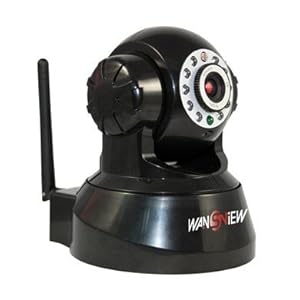
Price : $56.00
Product Description
Specs: Image Compression Format: M-JPEG standard Image Resolution: VGA(640x480) / QVGA(320x240) Sensor: 1/4 inch CMOS, 300,000 Pixels Light frequency: 50Hz, 60Hz or Outdoor Audio compression: ADPCM Data rate: 802.11b: 11Mbps (Max.), 802.11g: 54Mbps (Max.) Ethernet: One 10/100Mbps RJ-45 Viewing angle: 67? Horizontal Rotating Angle: 0~270? Vertical Rotating Angle: 0~120? Alarm Mode: motion detection alarm and I/O alarm Video Display: Microsoft Media Player Image Transfer Velocity: 30fps VGA Image Display: single / quad Minimum Illumination: 0LUX Video Format: AVI Network Interface: Wi-Fi/RJ-45 10-100 Base T Network Protocol: TCP/IP, FTP,SMPT, HTTP, ICMP, PPPoE Monitor Mode: Firefox Software Upgrade: Automatic upgrade Security: User management system, password protection Password Setting: administer, monitor, scrutiny Working Condition: -10?C~ 50?C , 20% - 80%PH Power Adapter: DC5V/2A 50/60Hz Operating System: Windows 2000/Windows XP/Windows 7 and Apple MAC ? Package includes: 1 x IP Camera 1 x Antenna 1 x Base 1 x Power Adapter 1 x Network Cable 1 x CD Driver Screws Review Works under both Apple MAC and Safari. However, browser must be run under Firefox. To choose your browser, please enter into the IP camera home page and select Firefox

Consumer Reviews
The camera I got was branded EasyN, but the box art shown on the item info page matches the box I got. Some people claim they have Foscam, Apexis, Hootoo, etc. brand, but I consider it is the same camera branded in completely different brands to accommodate distinctive markets. I admit, it would Assist if you are tech savvy or at least have some expertise in network configuration to expedite the set up and get the camera operating, but that is not necessary. This camera isn't specifically the most fool-proof camera in the marketplace, but its feature make up for it.
The instructions are readable, albeit choppy due to the poor Chinese-to-English translation. OK here's the deal. I'm going to write a lengthy semi-assessment, semi-how-to for this awesome IP camera seeing the want for an instruction for Mac users. Initially of all, I am a Mac user running on OS X ten.7.two Lion and I got this poor boy up and running within an hour. For all you Mac users out there, you are going to have to have to have temporary access to a Windows machine.
If you don't have a Windows machine, see UPDATE four at the finish of this critique - then follow actions 3 and forward. I'm writing this assessment under the presumption that the typical user has no understanding of MAC access manage list or WiFi DHCP client table from your router to set-up the camera it through WiFi. You need to have it to run the application that makes it possible for you to detect and configure the camera's IP. However, this application is written for Windows only. But that's all you will need a Windows machine for. When you configure the camera's IP address to perform with your LAN, then you can use the internet interface and configure a whole sleuth of other options, which includes the alarm feature, FTP, Mail and other. So without adieu, let's do this!
I've taken screenshots to help accommodate the mini guide below. So check out the user-submitted pictures for 7+ pictures I've added for directions on how to proceed. The instruction is for connecting the camera to a LAN - I chose this route for the reason that my WiFi network is secured more than many layers of security (Sonic Wall fire wall, MAC manage, and so on.) and it is just a lot easier to get the cam up and running by way of the LAN.
.) Connect your IP camera to your LAN via ethernet and plug in the power supply.
1.) Get access to a Windows machine. I dual-booted to Windows Vista via Boot Camp. Make positive this Windows machine has access to your LAN.
2.) Run the application with the file name, DevFind.exe - you can discover it in the directory, /EasyN F2 series IP camera installation CD/computer software. My included install disc was a blank CD-R disc! so I had to download the CD content material ZIP from the manufacturer's web internet site: "easyntech . com / ShowDownload . asp ? id = 34" you can download the manuals in PDF format from the site also).
three.) Run the DevFind.exe to locate your camera, then modify the camera's IP address so that it matches your LAN's IP range structure, subnet mask and gateway. The default IP address assigned to the camera need to be indicated in a silver sticker located underneath the camera. The identical sticker can also be found on the exterior of the box. Essentially, the default IP really should be a thing along the line of 192 . 168 . 1 . 126 and access port 81 (it could be diverse). Because my LAN's IP range structure is 192.168..x, I have assigned the camera an IP address of 192 . 168 . . 155. I changed out the default port of 81 to 310. Comprehend me so far? When you got that down, click on the "APPLY" button to make the modifications.
4.) Click on the "Others" tab under the Gear Info field. Take note of the specifics located in the "MAC" field, it ought to be a 12 letter/quantity string of characters.
five.) If you have access controlled enabled in your router, then follow this step. If not, you can skip. What access control indicates is you only enable certain network devices permission to connect to your LAN. Even if the connecting client knows your WEP/WPA/WPA2 password, they nonetheless will not be able to connect to your Wi-Fi unless their device is registered to the access control list. The exclusive identifier of the network device is its MAC address. If you have this enabled, then add the camera's MAC address you have just jotted down in the prior step to your router's access manage list. The convention should certainly be XX:XX:XX:XX:XX:XX exactly where X is a number or a character from the alphabet. So if your camera's MAC address is 00A8F700F341, enter it as 00:A8:F7:00:F3:41 Update and restart your router after entering. If you have the indicates to reserve IP address designation on your router, I would do so. Considering that I assigned the camera an IP address of 192 . 168 . . 155, I would reserve this address on the router to the camera's MAC address so that this IP does not get reassigned by the DHCP to one other network device by accident.
6.) You are going to most certainly have to have to port-forward your camera if you program to remote view from outside. In your router setup, go to the "Port Forwarding" page - it's frequently below "Advanced setup" or one thing comparable. Given that I assigned the camera a custom port of 310, I would enter the port range starting and ending at 310 to be forwarded to the camera's IP address of 192 . 168 . . 155 .
7.) Subsequent, you need to be able to punch in the IP address and port number you've assigned to the camera as noted on step 3 onto your internet browser and launch the web-based utility app e.g. http:// 192 . 168 . . 155:310. When you very first try to access the camera via a internet browser, it will ask you for a username and a password. This data is located underneath the camera and also on the box. It is ordinarily "admin" for the username and a blank password, but double check your equipment.
8.) Select the viewing system if you are working with IE choose the very first link, if you're utilizing Firefox, pick the second link, etc.
9.) View your camera, manage it, and so on
10.) Click on the Solutions icon to access the internet-based configuration app, or punch in http:// 192 . 168 . . 155:310 /admin2.htm to access it straight
11.) Configure all sorts of other goodies, such as FTP access, Email, alarm, DDNS, Alias, and so on.
12.) If you want to view your camera from remote (i.e. outside of your residence network), assuming you have a static IP, then you want to punch in your ISP assigned IP address, followed by your port. You can get out your ISP assigned address by going into your router and seeking at the information situated in the "simple setting" region. Thanks to daniel for pointing this out. If you have a dynamic IP address, then I advocate signing up for a dynamic DNS server, such as dyndns.org. Be certain to update the DDNS area of the web utility with the suitable login credential to your dynamic DNS provider.
I am operating on the wireless LAN setup, so I'll edit this evaluation as soon as I have a positive fire way to set it up so I can append a effortless how-to to aid people get started. Any question, just comment. Again, this is from a Mac OS X Lion ten.7.2 user (at the time of this writing).
Considering that I am a Mac user, the IP Camera utility is USELESS (unless you happen to be applying Parallel or Fusion to run Windows). I rely solely on the net-based interface to view the camera. It operates like a charm so far. The camera's pan and tilt function is SUPER rapidly. Of course, that's given that I set it at the fastest level you can set it according to your taste. You can set up the Alarm function so that its motion detector can pick up motion contingent on how sensitive you set the camera to behave. When the alarm mode is triggered, you can further instruct the camera to upload screenshots at set intervals to an FTP server and/or e mail you the screenshots to an e mail address (see pictures). You certainly do not have to have to be Cisco or A+ certified to get this camera to operate.
EDIT: As for scheduling the motion-detector, it functions if you set it appropriately. From the net-configuration utility, click on "Alarm Service Setting." Set the sensitivity level, etc., then check if you want to have the camera email you and/or take screenshots of events triggering the alarm and upload to a designated FTP server. I checked both. For the scheduler, check "Scheduler" to bring up a week calendar with hour. Click on the hours you'd like the camera to trigger its motion-detector, then press "Set". Note that the alarm mode won't go into influence immediately after about 30 seconds soon after rebooting. I didn't know this at first and believed this function was defunct from factory. I'm guessing the camera is giving you time to evacuate the premise before arming itself. The scheduling calendar is particularly cumbersome, so it is probably less complicated to just turn on or turn off the motion detector.
Also considering that you will need Online Explorer to use the ActiveX enabled net interface, Mac users will luck out. The IE version of the internet interface makes it possible for you to record video (AVI format), take a snapshot, listen and talk by way of your camera, along with the potential to command many cameras. It also appears that the remote on/off switch operates with the ActiveX IE control interface, but doens't for the other interfaces. I haven't had time to completely test them.
UPDATE two: I reside in an apartment complicated exactly where I gave permission to the leasing staff to deliver packages into my apartment when I am not household to sign for it. I set up the camera for motion detection and it picked up the delivery, snap a couple of shots and emailed to me in addition to continuously snapping shots in five seconds interval and uploading it to the FTP server. Just great for $5x.00.
I'm so impressed with this camera I'll be buying two way more units, possibly in white so they can blend with the white walls.
UPDATE three: For WiFi, make confident your router is 802.11 a/b/g compatible and set at 2.4ghz frequency. The IP camera will not choose up your router if it's set at 5 ghz at N-mode only... Read more›
Beware of this cam unless your have really good network and webcam setup expertise. The instructions are so poorly translated into English that it really is laughable. The setup computer software will stump you rapidly unless you know your way around network config, IP cams and the particulars of your existing residence network. The included "Super Client" software appears to be a trial product that you must decide to purchase if you want to use it longer than one particular hour per day. I do not recall any mention of that in the Amazon item descriptions. At least I can not obtain any included reg code and each time your run the computer software you are prompted to download a new version...the similar version you just downloaded.
The cam displays beneficial good quality video. Pan and tilt operate fine. Ftp solutions are actually non-existent. For example, I need to have to ftp through daylight hours only. There is no way to schedule ftp...it's either on or off. Period.

No comments:
Post a Comment